
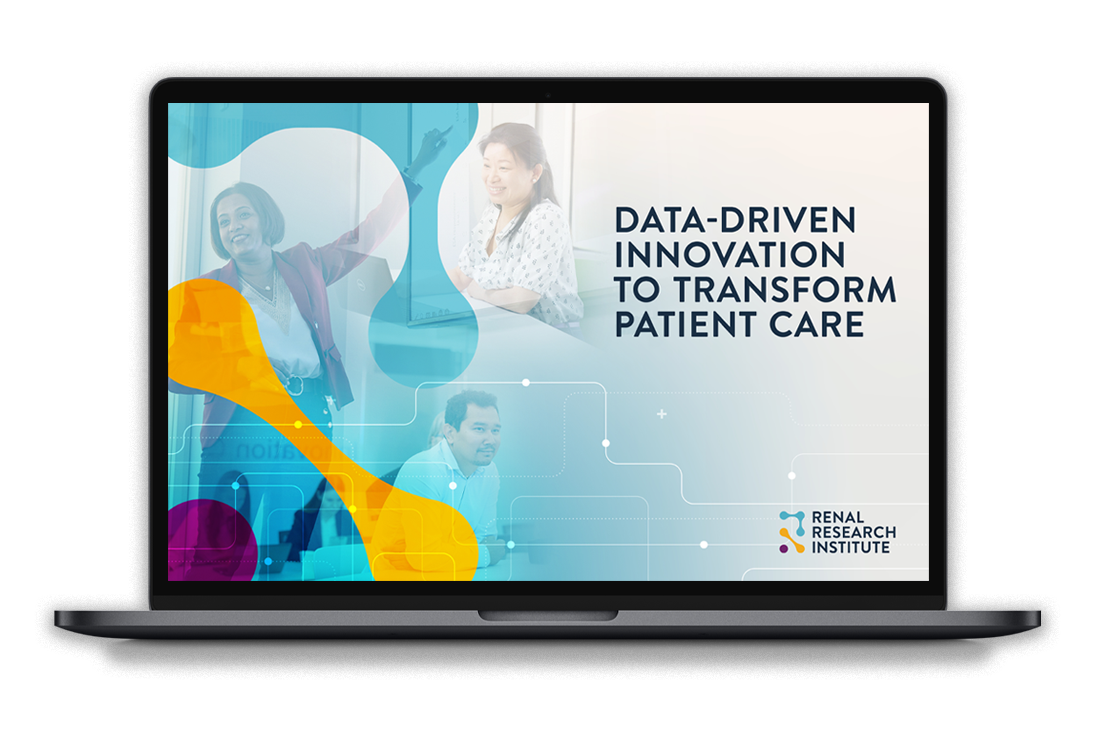



A highly diverse team imagining the undiscovered

RENAL RESEARCH INSTITUTE

Transforming
patient care
through data-driven
innovation

ABOUT THE RENAL RESEARCH INSTITUTE

The heart of RRI’s capacity for innovation is our ability to examine complex problems through multiple lenses.

The Renal Research Institute (RRI) is an internationally recognized incubator of ideas, treatment processes, and technologies to improve the lives of kidney patients. RRI’s leadership in data analytics, computational biomedicine and AI, as well as our access to a large patient population, accelerates the pace of scientific discoveries and their translation into applied medicine. Our team includes some of the brightest minds from around the world, who, along with their disciplinary expertise, bring a deep understanding of global healthcare issues and challenges.


Our Research

We operate at the intersection of clinical data, machine data, and real-world practice, with access to a large patient population and one of the world's largest and richest renal datasets. Our deep connection to the scientific community and to med-tech innovators gives us the rare ability to translate insight into action—quickly, precisely, and meaningfully.


Latest Research & News

Latest Research

  • Yan Zhang, Anke Winter, Linda H Ficociello, Smriti Arya, Stefano Stuard, Len A Usvyat, Kamyar Kalantar-Zadeh

    RESULTSBaseline characteristics between HDF and hemodialysis groups were comparable after inverse probability of treatment weighting. Over a median follow-up of 15.7 months (interquartile range, 6.4-24.0 months), HDF was associated with a lower risk of all-cause mortality compared with hemodialysis (11.7 versus 15.6 per 100 person-years; hazard ratio, 0.80; 95% confidence interval, 0.75 to 0.86). Furthermore, HDF was associated with a lower risk of cardiovascular disease mortality compared with hemodialysis (4.1 versus 6.7 per 100 person-years; hazard ratio, 0.71; 95% confidence interval, 0.63 to 0.80).KEY POINTSHigh-volume hemodiafiltration was associated with a 20% lower all-cause mortality risk compared with hemodialysis in incident patients. High-volume hemodiafiltration was associated with a 29% lower cardiovascular mortality risk compared with hemodialysis in incident patients. Associations between high-volume hemodiafiltration and lower mortality were consistent across demographic and clinical subgroups.CONCLUSIONSIn the large real-world cohort of incident patients with ESKD who are in the early phase of dialysis treatment, online HDF was associated with a significant survival advantage compared with conventional hemodialysis. These findings reinforce the potential clinical benefits of HDF and support early adoption of HDF upon dialysis initiation.BACKGROUNDEvidence for a survival benefit of hemodiafiltration (HDF) over high-flux hemodialysis largely comes from studies based on prevalent ESKD patients with longer dialysis exposure. By contrast, the effect of HDF on mortality of incident patients-those newly starting dialysis-remains less well understood.METHODSWe analyzed data from 18,515 incident patients (dialysis vintage <3 months) treated between 2019 and 2022 at Fresenius Medical Care NephroCare Clinics. Patients were classified as HDF or hemodialysis on the basis of their predominant dialysis modality during the first year of follow-up (≥75% of sessions). To assess the effect of HDF in the early phase after treatment initiation, follow-up was limited to 2 years. Cox proportional hazards models with inverse probability of treatment weighting were applied to estimate all-cause and cardiovascular disease mortality risk.

No Results Found

Latest News

No Results Found

Program

LATEST EPISODE

Beyond the Equation | Dr. Amaka Eneanya on Kidney Function, Clinical Change, and Communication

March 2, 2026

In this episode of Frontiers in Kidney Medicine and Biointelligence, host Len Usvyat, MD, is joined by Amaka Eneanya, MD, MPH, FASN, Adjunct Professor of Medicine at Emory University School of Medicine and former Chief Transformation Officer at Emory Healthcare. Dr. Eneanya reflects on kidney function estimation, the evolution of clinical tools in nephrology, and the role of communication, patient perspectives, and digital platforms in shaping medical discourse. This episode offers an in-depth discussion on how research findings move from theory into real-world clinical practice.