
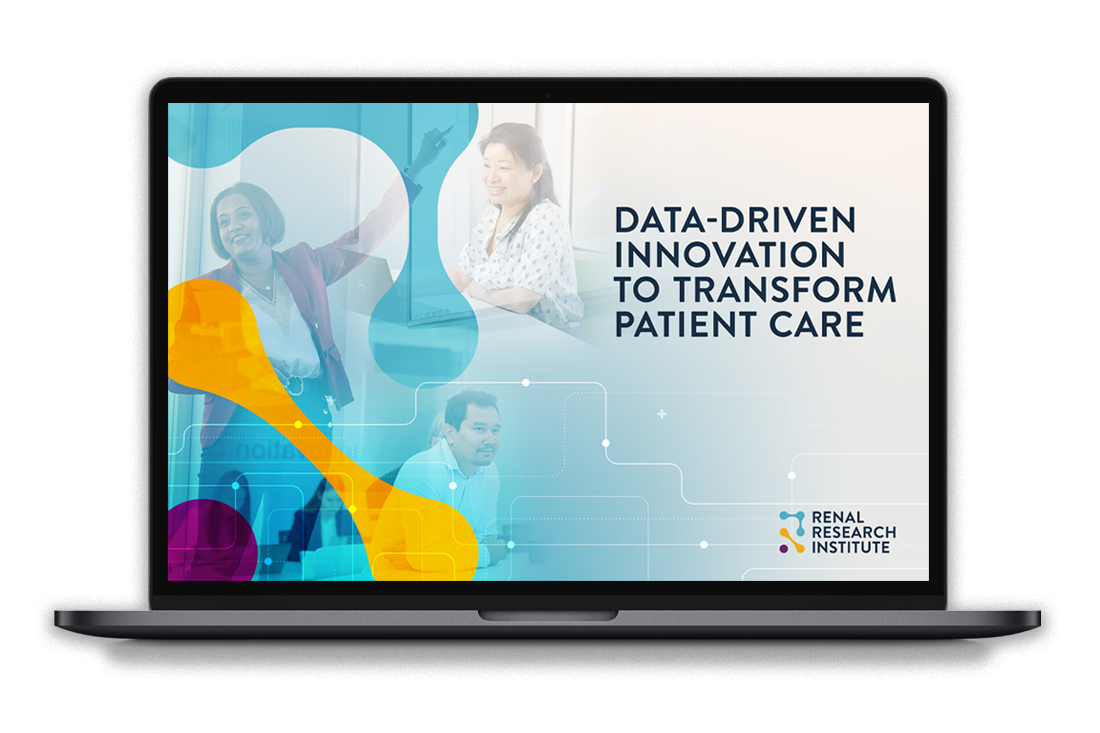



A highly diverse team imagining the undiscovered

RENAL RESEARCH INSTITUTE

Transforming
patient care
through data-driven
innovation

ABOUT THE RENAL RESEARCH INSTITUTE

The heart of RRI’s capacity for innovation is our ability to examine complex problems through multiple lenses.

The Renal Research Institute (RRI) is an internationally recognized incubator of ideas, treatment processes, and technologies to improve the lives of kidney patients. RRI’s leadership in data analytics, computational biomedicine and AI, as well as our access to a large patient population, accelerates the pace of scientific discoveries and their translation into applied medicine. Our team includes some of the brightest minds from around the world, who, along with their disciplinary expertise, bring a deep understanding of global healthcare issues and challenges.


Our Research

We operate at the intersection of clinical data, machine data, and real-world practice, with access to a large patient population and one of the world's largest and richest renal datasets. Our deep connection to the scientific community and to med-tech innovators gives us the rare ability to translate insight into action—quickly, precisely, and meaningfully.


Latest Research & News

Latest Research

  • Peter Kotanko, Linda Hanna Ficociello, Frank van der Sande

    PURPOSE OF REVIEWThere are concerns that online high-dose hemodiafiltration (HDF) is particularly resource-intensive and environmentally challenging. It has recently been suggested that HDF consumes more water and generates more plastic waste than expanded hemodialysis (HDx) using medium cut-off membranes. To further address this matter, we examined the available evidence on water use and plastic waste generation across high-flux hemodialysis, HDx, and HDF.SUMMARYDespite the suggestive 'high-dose' attribute in its name, online high-dose HDF with optimized dialysate flow may use less water and generates substantially less plastic waste than HDx. These findings challenge the view that HDF adoption is environmentally costly and indicate that HDF is a meaningful step towards green dialysis.RECENT FINDINGSOur analysis reveals that plastic waste generation is lowest with HDF and highest with HDx: modern HDF dialyzers weigh on average 36% less than MCO dialyzers, and online HDF requires no saline bags, together saving approximately 68-123  kg of plastic per 1000 sessions compared to HDx. Regarding water, online high-dose HDF may use less water than HD or HDx if dialysate flow is minimized/optimized (-8% vs. hemodialysis at standard European dialysate flow; -12.6% in a US setting). Individualization of dialysate flow reduces water consumption by a further 27.8% without compromising dialysis adequacy.
No Results Found

Latest News

No Results Found

Program

LATEST EPISODE

Beyond the Equation | Dr. Amaka Eneanya on Kidney Function, Clinical Change, and Communication

March 2, 2026

In this episode of Frontiers in Kidney Medicine and Biointelligence, host Len Usvyat, MD, is joined by Amaka Eneanya, MD, MPH, FASN, Adjunct Professor of Medicine at Emory University School of Medicine and former Chief Transformation Officer at Emory Healthcare. Dr. Eneanya reflects on kidney function estimation, the evolution of clinical tools in nephrology, and the role of communication, patient perspectives, and digital platforms in shaping medical discourse. This episode offers an in-depth discussion on how research findings move from theory into real-world clinical practice.